Meeting recap
A special thank-you to colleagues whose questions, critiques, and perspectives helped move the FIRST discussion forward.
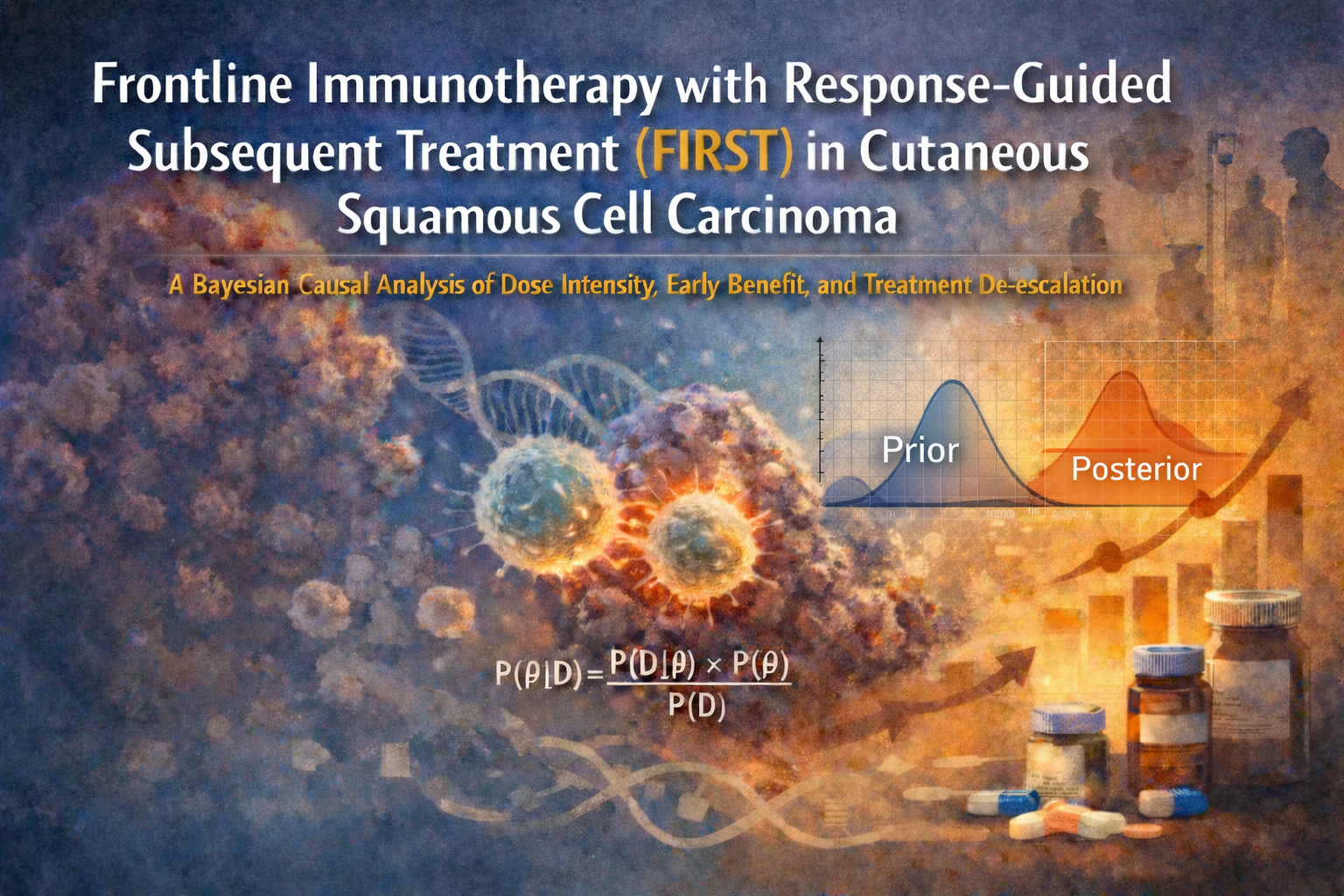
The clinical question
Frontline immunotherapy can produce rapid and clinically meaningful responses in cutaneous squamous cell carcinoma. But once that response has occurred, an important question remains: how much additional treatment is necessary?
The FIRST analysis examines whether early treatment response can help guide subsequent management, including the possibility of reducing treatment intensity rather than continuing therapy according to a fixed duration.
Can the response already achieved after frontline immunotherapy help determine what treatment a patient actually needs next?
Questions explored
Early benefit
How much information about subsequent outcome is already present after the earliest doses of immunotherapy?
Dose intensity
Does additional treatment meaningfully improve outcomes once an early clinical benefit has been achieved?
Response-guided treatment
Can subsequent management be adapted to observed response rather than determined by a fixed treatment duration?
Treatment de-escalation
Could selected patients receive less systemic therapy without compromising meaningful clinical benefit?
Why causal inference matters
Treatment intensity in FIRST was not randomly assigned. Patients who received fewer versus more doses therefore cannot be compared as if they had been randomized to those treatment strategies.
The analysis used Bayesian causal methods to address measured differences between treatment groups and to estimate clinically interpretable relationships between dose intensity, early benefit, and subsequent outcomes.
The relevant question is not simply whether patients who received less treatment did well. It is whether the observed data support a credible estimate of what might have happened under different treatment intensities.
Discussion themes
- Early response as a potential treatment-decision landmark.
- The relationship between cumulative dose intensity and subsequent clinical outcomes.
- Scheduled dose intensity versus delivered dose intensity. Ann W. Silk raised an important limitation in the original analysis: simply counting doses does not account for treatment delays or other deviations from the expected dosing schedule. That discussion prompted a regimen-adjusted dose-intensity sensitivity analysis that standardized observed treatment exposure to the expected interval for each therapeutic regimen.
- Confounding created by non-random treatment continuation and discontinuation.
- Bayesian approaches to estimating treatment effects in observational treatment patterns.
- The clinical rationale for response-adapted treatment de-escalation.
- How these findings might inform future prospective trials of individualized treatment duration.
Instead of asking every patient to complete the same predetermined course of therapy, response-guided treatment asks whether subsequent management can reflect the benefit that an individual patient has already achieved.
Toward response-guided care
The broader goal of FIRST is not simply shorter treatment. It is a more adaptive treatment strategy: initiate effective systemic therapy, measure early benefit, and allow subsequent management to respond to the biology and clinical response of the individual patient.
What happened next?
The discussion changed the analysis
The March Research Forum was not simply a presentation of work in progress. Feedback from the group materially changed the manuscript. In particular, Ann W. Silk's observation that dose counts alone could miss treatment delays and other departures from the planned schedule led to the development of a regimen-adjusted dose-intensity variable for sensitivity analyses. The final paper explicitly acknowledges that contribution.
This is exactly why the Research Forum exists: putting unfinished work in front of thoughtful colleagues early enough that their criticism can still alter the analysis, improve the manuscript, and sharpen the scientific story.
Who joined us?
The attendance record is preserved as part of the meeting recap. The roster below is limited to names and institutional affiliations.
Attendance roster View names and affiliations
| Name | Affiliation |
|---|---|
| Aleigha R. Lawless | Mass General Brigham |
| Ann W. Silk | Dana-Farber Cancer Institute |
| Annie Chang | Harvard Medical School |
| Claire Verschraegen | The Ohio State University |
| David M. Miller | Mass General Brigham |
| Elizabeth I. Buchbinder | Mass General Brigham |
| Howard L. Kaufman | Mass Eye and Ear |
| Isaac Brownell | National Institutes of Health |
| Jacob Choi | Northwestern Medicine |
| Kamaneh Montazeri | Mass General Brigham |
| Karam Khaddour | Dana-Farber Cancer Institute |
| Ken Tsai | Moffitt Cancer Center |
| Manisha Thakuria | Mass General Brigham |
| Mariam El-Ashmawy | UT Southwestern Medical Center |
| Meghan J. Mooradian | Mass General Brigham |
| Michael Wong | Roswell Park Comprehensive Cancer Center |
| Ross D. Merkin | Mass General Brigham |
| Ryan J. Sullivan | Mass General Brigham |
| Sameer Gupta | Mass Eye and Ear |
| Sanjay Chandrasekaran | UT Southwestern Medical Center |
| Song Park | University of Washington |
| Suzanne Topalian | Johns Hopkins Medicine |
| Vern Sondak | Moffitt Cancer Center |
| Vishal Patel | George Washington University |
| William J. Benjamin | Mass Eye and Ear |
| William T Reed | MaineHealth |